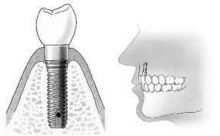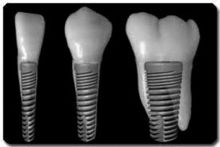
Teeth have a visible part (crown) and an invisible part (root).
When a patient visits a dentist with an infected or damaged tooth, often the dentist is able to treat it in order save your own natural tooth.
However, sometimes this isn’t possible, and then it is necessary to extract the tooth.
To fill the gap and replace that tooth, a bridge is a feasible option,
but only if there is a sufficient number of healthy adjacent teeth to attach it to.
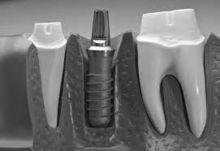
Fortunately, we can nowadays use implants (artificial roots) in such a case, which provide a comfortable and durable solution.
Implants are less expensive than generally believed.
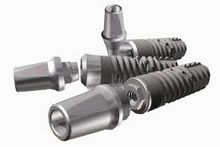
An implant looks like a screw and is made of body-friendly titanium, which fuses well to the jaw bone. This provides the basis for a crown or bridge. Implants can be inserted to replace one or more teeth or even all your teeth. Depending on the chosen solution, one or more implants are placed.
Implants are inserted under local anaesthetics, after which the surrounding gum tissue is stitched. After 2-3 months the implant would have fused with your bone, and a crown or bridge can be placed. We will, of course, first consult with you to determine the best solution for you.
Most people do not experience much inconvenience after an implant has been placed. You can take ordinary painkillers if you feel any pain or if your gums are sensitive. It takes about two to three months for the implant to fuse with your bone. During this period you must make sure you do not exert too much pressure on it. You may therefore be required to change your diet temporarily. We will, of course, give you the necessary advice.
Once the crown, bridge or prosthesis has been placed, you need to take good care of your teeth. We will discuss this with you. We will do regular check-ups to closely monitor the condition of your gums and jaw bone. If necessary we will take some more X-rays.
From the first visit, we will carefully study your case for a personalized diagnosis and explore with you the different possibilities to find the solution that suits you best.
Of course, throughout the treatment process we will be by your side, explaining you every step of the treatment.
Implant supported prosthesis (either fixed or removable) allow to chew the food better, speak more clearly and they have a superior stability.
The type of dentures you ultimately choose should be designed to best serve you for years to come. While both fixed and removable dentures are viable options for long-term use, there are some differences in their care and maintenance that might be helpful to discuss with your dentist.
As opposed to removable options, permanent non-removable dentures need to be cleaned and maintained with excellent oral hygiene practices, including daily use of interdental brushes and regular visits to the dentist and Hygienist, at least every 6 months for check-ups, and deep cleaning
Therefore, non-removable dentures are not a suitable option for patients who have poor hygiene habits.
Do you want to know more? We will be more than happy to give you the information you need.
During the month of August, we will have limited availability for dental treatments and emergencies.
We will be available on Mondays, Wednesdays and Fridays, mornings only.
To make an appointment, you can contact us by telephone Monday to Friday between 9:00 AM and 7:00 PM on (+34) 966 495 006.
In exceptional circumstances and for dental emergencies that cannot wait, you can contact our emergency number outside these hours on (+34) 675 507 358.
Emails will not be monitored during August and will only be reviewed again towards the end of the month.
Decide which cookies you want to allow.
You can change these settings at any time. However, this can result in some functions no longer being available. For information on deleting the cookies, please consult your browser’s help function.
Learn more about the cookies we use.